Everything you need to know about Onfido
Last updated: May 2, 2026
Onfido (now part of Entrust following its acquisition in April 2024) is a global identity verification platform that combines AI-powered document analysis with biometric liveness detection to verify a person's identity against a government-issued document. Supporting over 2,500 document types across 195 countries, it is one of the most widely adopted IDV providers on the market.
On Dotfile, Onfido powers the Liveness ID Verification Check — a document scan combined with a real-time biometric check confirming the person presenting the document is genuinely present. It is the recommended default IDV provider on Dotfile.
Documents supported by Onfido
Onfido supports over 2,500 document types from 195 countries. The Document report employs data integrity, visual authenticity and MRZ/database record checks to verify the document's authenticity and extract identity data.
Document type | Coverage Notes |
Passport | Broadest coverage — supported across nearly all countries. NFC chip reading is supported for electronic passports where the SDK configuration allows it. See NFC for Document report. |
National ID Card | Supported across most European and major international markets. Both sides are typically required. Document coverage is continuously expanded with each Onfido release |
Driver's Licence | Supported across major markets. OCR and authenticity models are regularly updated by region, with improvements published in Onfido's release notes. |
Residence Permit | Supported in key markets. Processing time may vary depending on the complexity of the document specimen |
Visa | Selected visa types supported, including Schengen visas for multiple European countries. |
Custom Configurations
One of Onfido's key differentiators on Dotfile is the ability to restrict accepted documents. You can contact Dotfile support to know more information on this.
How is Onfido IDV billed?
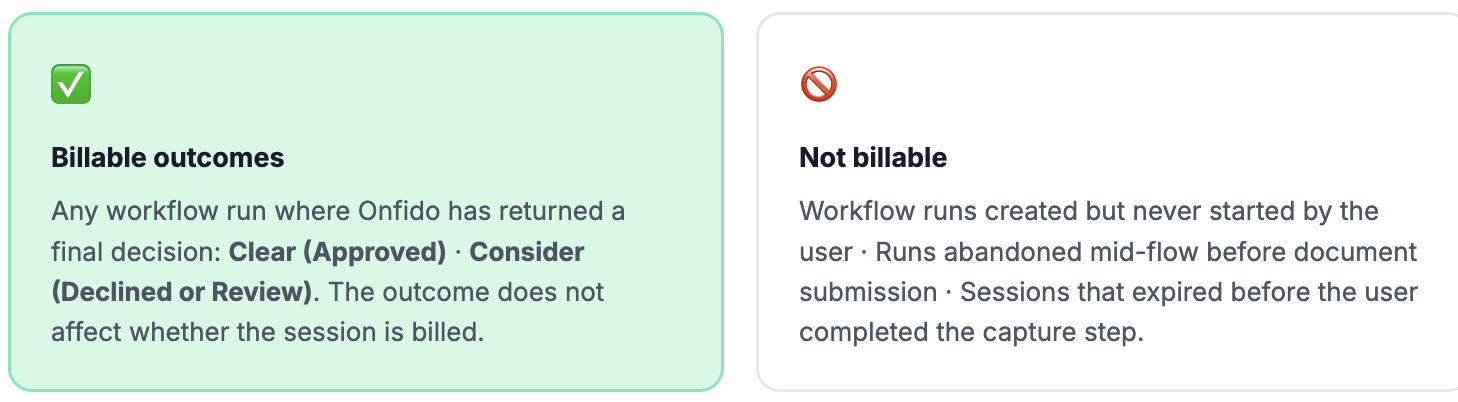
Onfido charges per completed workflow run. Billing is triggered when Onfido returns a final decision on the check whether the outcome is clear or consider. Workflow runs that are initiated but abandoned or expired before the user submits their documents do not generate a charge.
Each workflow run is billed independently
If a user fails a check and you want to give them another opportunity to verify, a new workflow run must be created. Unlike some other providers, there is no built-in multi-attempt session: each run is a separate billable event if it reaches a final decision. Plan your retry logic accordingly, particularly for high-volume onboarding flows.